
Amazon Portfolio Profitability Turnaround
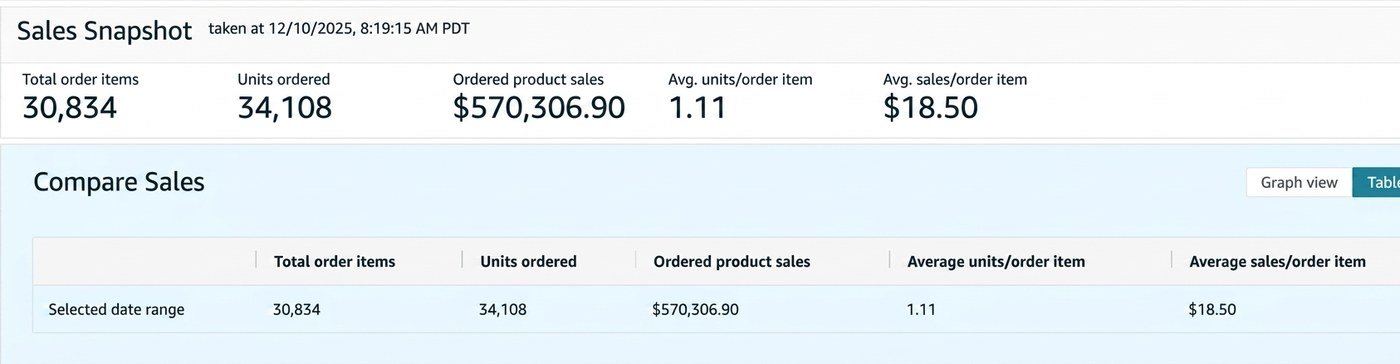
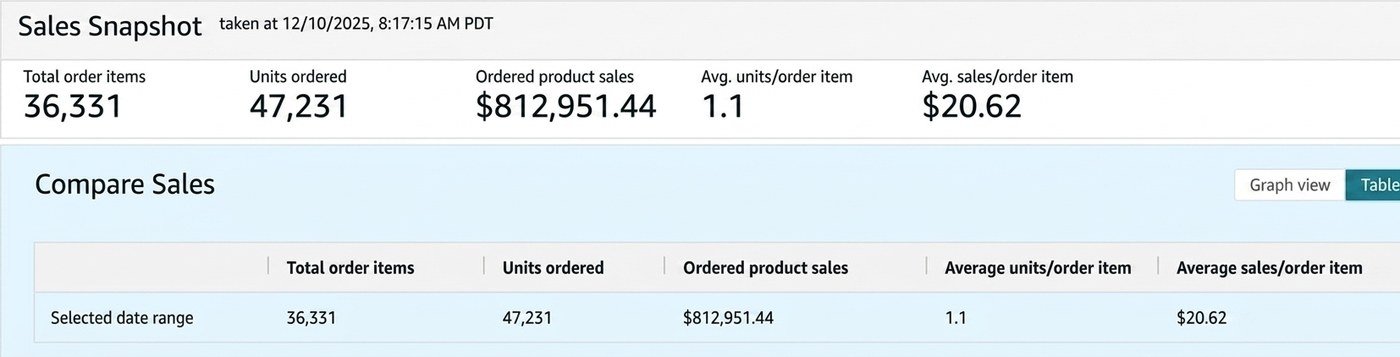
How an anonymized supplement portfolio grew Amazon ordered product sales from $570K to $813K in a 9-month management window while improving PPC control, order volume, AOV and operating visibility.
Back to Case StudiesHeadline Outcome
The account had demand, but performance was held back by scattered campaign structure, unclear budget priorities and limited visibility into contribution margin. TAM rebuilt the growth system around campaign control, search-term discipline, conversion accountability and weekly KPI ownership.
Before / After Performance Proof
The proof visuals are intentionally stacked vertically so visitors can clearly compare the account before TAM management and after TAM management. The screenshots are cropped to avoid exposing any client, store, account, product, ASIN or seller identity.
What Was Holding Growth Back
Inefficient campaign architecture
Campaigns were not separated clearly by intent, match type, product role or scale stage, making budget decisions slower and less precise.
No budget priority framework
Spend was distributed too broadly instead of being protected around core revenue drivers and tested in controlled expansion pockets.
Low margin visibility
Ad decisions needed better connection to net unit margin, inventory exposure and contribution margin, not only ACOS.
Reporting without ownership
The brand needed a weekly decision rhythm that connected revenue, TACOS, conversion rate, inventory and action owners.
What TAM Changed
The strategy focused on making Amazon growth more measurable and easier to control. TAM rebuilt campaign structure, improved search-term discipline, tied budget decisions to product roles and created a simple operating cadence for the brand.
PPC restructuring
Separated campaigns by search intent, match type, product role and performance stage so budget could move toward proven areas.
Search-term control
Reviewed search terms for harvesting, negatives, bid changes and top-of-search opportunities based on conversion quality.
Conversion accountability
Connected listing quality, offers, traffic quality and sales performance into one weekly review instead of treating them separately.
Portfolio operating rhythm
Built weekly reporting across revenue, ACOS, TACOS, contribution margin, inventory turn and cash-flow exposure.
First 90-Day Roadmap
Audit and control
Review campaign structure, spend leakage, product roles, search terms, margin visibility and reporting gaps.
Optimization system
Rebuild campaigns, prioritize budgets, improve conversion inputs and define weekly KPI ownership.
Scale and ownership
Move budget into proven areas, expand portfolio opportunities and tighten reporting for faster decisions.
What Brand Owners Can Learn
Growth follows prioritization
Not every product or campaign should receive equal spend. The highest-impact areas need clear protection.
ACOS needs profit context
Advertising decisions are stronger when ACOS is reviewed with margin, inventory and cash-flow visibility.
Reporting changes behavior
Weekly KPI ownership helps ecommerce teams make faster decisions and reduces operational drift.
Scale needs operating discipline
Repeatable growth comes from systems, not only more ad spend or one-time listing changes.
Related growth paths
Use these internal resources to move from proof to execution across Amazon growth, PPC control, marketplace operations and ecommerce strategy.
Back to ecommerce case studies
Review more proof-led growth stories and anonymized performance snapshots.
Amazon PPC and performance marketing
See how we rebuild campaigns, reduce wasted spend and scale profitable demand.
Amazon account growth services
Explore the operating system behind listing, advertising, SEO and marketplace growth.
Request a portfolio audit
Ask TAM to review the highest-impact revenue and profitability levers in your account.
Want TAM to review your ecommerce growth system?
Share your Amazon, D2C or marketplace goals and we will map the highest-impact growth levers first.